Last Updated: October 26, 2026
Quick Summary
When your fridge stops cooling, first move perishables into a cooler with ice, then confirm the temperature with a thermometer and check the power cord, outlet, and breaker. If those basics are fine, clear blocked vents, vacuum the condenser coils, and test the door seals before calling a technician.
A warm fridge is a race against time: the USDA’s Food Safety and Inspection Service advises discarding refrigerated food held above 40°F for more than two hours. At Ramex ProFix, we walk homeowners through the same first steps our technicians use when a fridge stops cooling, starting with the free checks that rule out the most common culprits.
Before you touch anything, move perishables into a cooler with ice. Then work through the basics in order.
Most “dead fridge” calls trace back to one of these simple issues, not a failed compressor.
Work from the safest, lowest-cost observations to technician-only tasks, and stop as soon as you find the fault. This sequence keeps you away from electrical and sealed-system hazards while narrowing the cause fast.
Stage 1, Observe and record (no tools, no risk).
Stage 2, Low-risk user checks.
Stage 3, Maintenance-level tasks (unplug first).
Stage 4, Technician-only work.
Use what you observe to skip straight to the likely culprit.
| Symptom | Likely Cause | Next Step |
|---|---|---|
| Fridge warm, freezer cold | Evaporator fan, defrost fault, or iced vent | Check fan, defrost 24 hours |
| Fridge and freezer both warm | Power, settings, condenser coils, or compressor | Stage 1-3 checks |
| Clicking but not running | Start relay or compressor | Call technician |
| Silent unit, no lights | Power supply or control board | Test outlet, reset breaker once |
| Frost returns within days | Defrost heater or timer failure | Technician |
| Warm spots, uneven cooling | Blocked vents or overloaded shelves | Reorganize food, clear vents |
If the freezer is cold and the fridge is warm, skip compressor and refrigerant checks for now. If both compartments are warm and the unit is silent, start with power.
After a reset, power outage, or repair, the fridge does not cool instantly:
If the temperature is still climbing after 24 hours, or the compressor never starts, call a technician. Keep a thermometer inside to track the trend rather than guessing.
A refrigerator not cooling but freezer works usually points to an airflow or defrost problem rather than a dead compressor. The freezer keeps making cold air; the question is why it never reaches the fridge compartment.
Here’s the short list of usual suspects:
If the freezer is cold and the fridge is warm, you can skip the compressor and refrigerant checks entirely for now.
Open the freezer and press the door switch. You should hear the fan running. Silence means the fan motor has failed or is jammed with ice.
Next, look for heavy frost on the freezer back panel. Thick ice suggests the defrost heater or timer has failed; without the regular melt cycle, ice slowly seals off the vent that feeds the fridge.
If ice production is also affected, dedicated ice maker repair in Orlando, Kissimmee & St. Cloud may be the right next step.
Cold air moves through your fridge like water through pipes: block one vent and the whole compartment warms up.
Then clear the path:
An overloaded refrigerator is a hidden cause of warm spots; cold air needs open space to travel. After a big grocery run, expect uneven temperatures for a day or two.
Also check the vent between freezer and fridge. If it’s iced over, defrost fully for 24 hours with the doors open and towels down, that single step fixes a surprising number of warm-fridge complaints.
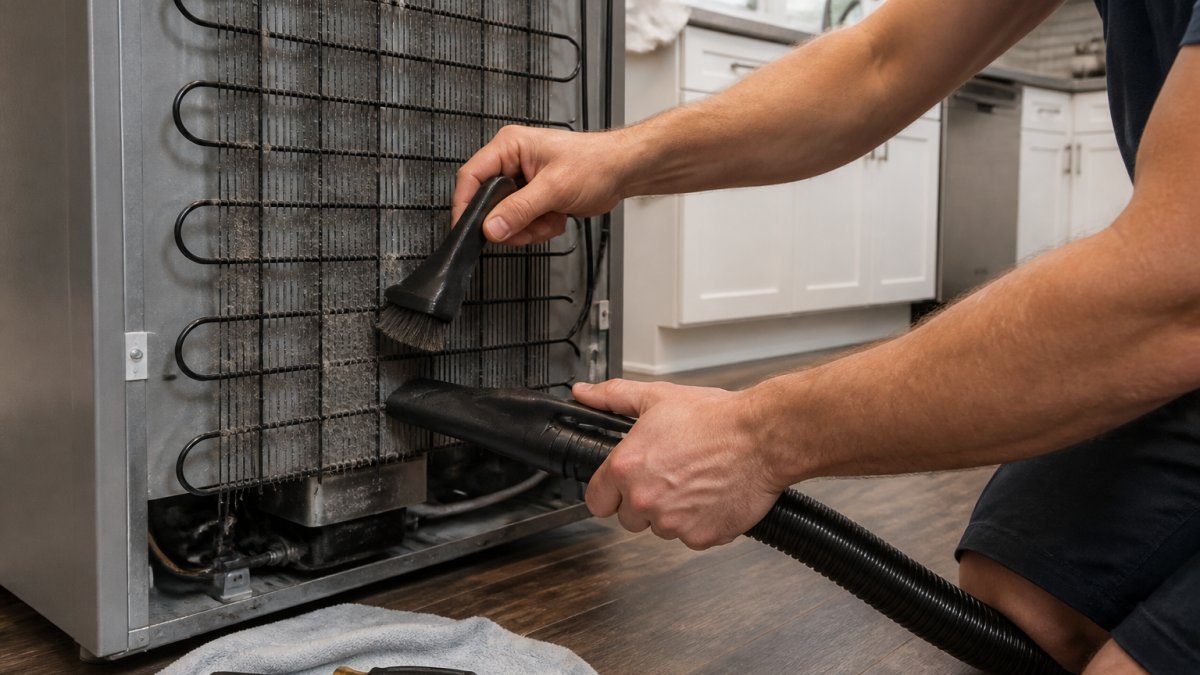
Refrigerator condenser coil cleaning is the most overlooked maintenance task in most homes.
Here’s how to do it:
Watch out: coil fins are sharp and bend easily. Use light pressure and never poke with a screwdriver.
Plan on cleaning coils every six to twelve months. Homes with pets or heavy dust need it more often.
With the fridge unplugged, spin the condenser fan blade by hand; it should turn freely. A stiff or noisy fan needs replacement, and a fan that isn’t running can cause overheating and poor cooling.
Listen to the compressor while the fridge runs: a steady hum is normal, while loud rattling, clicking, or total silence points to a compressor or start relay problem.
A worn door gasket lets warm air in all day long. Test each seal with the dollar-bill trick: close the door on a bill so half hangs out, then tug gently.
Check all four sides of both doors for tears, cracks, or a gasket that’s flattened and no longer springy. Clean the sealing surface with warm soapy water; sticky residue keeps gaskets from seating.
Then cut down on warm-air leaks:
A gasket replacement is a straightforward fix and one of the cheapest ways to restore cooling performance.
How long food lasts in a refrigerator without power depends on whether the doors stay closed. A closed fridge keeps food safely cold for about four hours; a full freezer holds temperature for roughly 48 hours, a half-full one about 24.
Use this quick reference:
| Situation | Safe Window | What to Do |
|---|---|---|
| Fridge, door kept closed | About 4 hours | Keep closed, add ice if needed |
| Freezer, full, door closed | About 48 hours | Don’t open until power returns |
| Freezer, half full, door closed | About 24 hours | Group food together to hold cold |
| Food above 40°F for 2+ hours | Unsafe | Discard perishables |
When in doubt, throw it out. Replacing groceries costs far less than a foodborne illness. Keep an appliance thermometer in the fridge so you know the real internal temperature, not a guess.
Stop troubleshooting and call a technician when you’ve reset the breaker, confirmed the settings, cleared the vents, cleaned the coils, and checked the seals, and the fridge is still warm. Those five checks cover most DIY-fixable causes; what’s left usually involves sealed-system work, control boards, or fan motors that need proper tools.
Call right away if you notice any of these:
A common rule of thumb is to replace an appliance when a repair costs more than half the price of a new unit. For a decade-old fridge, a sealed-system repair often isn’t worth it; for a newer one, the math usually favors repair.
Weigh the repair quote against replacement, remaining warranty, and the unit’s age. If the fridge is under warranty, check coverage before authorizing work; sealed-system coverage often extends longer than the general warranty.
Before you assume a fault, rule out a setting that mimics one:
Write down any error code before resetting. That code saves diagnostic time and often points straight to the failed part.
We provide upfront estimates before any work begins, so you can weigh repair against replacement with real numbers. If you have questions about diagnostics, estimates, or warranty coverage, our appliance repair questions, answered page covers the details. You can also review our repair warranty before you commit. And if you decide it’s time for a pro, refrigerator repair in Orlando, Kissimmee & St. Cloud is one call away.
A warm fridge won’t wait, and neither should you. Ramex ProFix offers same-day and next-day repair across Orlando, Kissimmee, St. Cloud, and surrounding communities.
We diagnose major appliances professionally, so you never have to risk disassembling a sealed system yourself. Repairs are backed by a written warranty for eligible work.
Get started with Ramex ProFix and get your fridge cooling again. Book appliance repair in Central Florida today and Customer Support will confirm availability in your area.
Start with the simplest checks. Confirm the power cord is fully plugged in and the circuit breaker has not tripped. Open the doors and listen for the fans and compressor. Check that the temperature setting was not accidentally changed and that no vents are blocked by food containers. These steps take minutes and resolve a surprising number of cooling problems before you need to call anyone.
The USDA advises keeping refrigerator doors closed as much as possible. A closed refrigerator holds its temperature for about four hours; a full freezer holds for 48 hours, or 24 hours if half full. Discard perishable food that has been above 40 degrees Fahrenheit for more than two hours. When in doubt, throw it out rather than risk foodborne illness.
Yes. Condenser coils release heat from the refrigerator, and a layer of dust and pet hair forces the compressor to work harder and run hotter. Over time the unit loses cooling performance and may shut down. Cleaning the coils every six to twelve months, depending on pet hair and dust levels, restores airflow and is one of the most effective preventive maintenance tasks you can do.
Call a professional if you have checked power, settings, vents, coils, and door seals and the fridge still runs warm. Signs that need expert diagnosis include a compressor that is silent or clicking, frost buildup on the evaporator, refrigerant leaks, or repeated circuit breaker trips. A technician can test sealed-system components safely, which homeowners should not attempt to open or recharge themselves.
